




On the occasion of the exhibition "Remember Joseph Beuys", on 5 October the museum hosts an afternoon dedicated to the German artist, with a guided tour and a screening of the film "Lucrezia e Joseph Beuys" by director Pierdavide Tedeschi.
Where
When
From 20 February 2026 to 30 August 2026
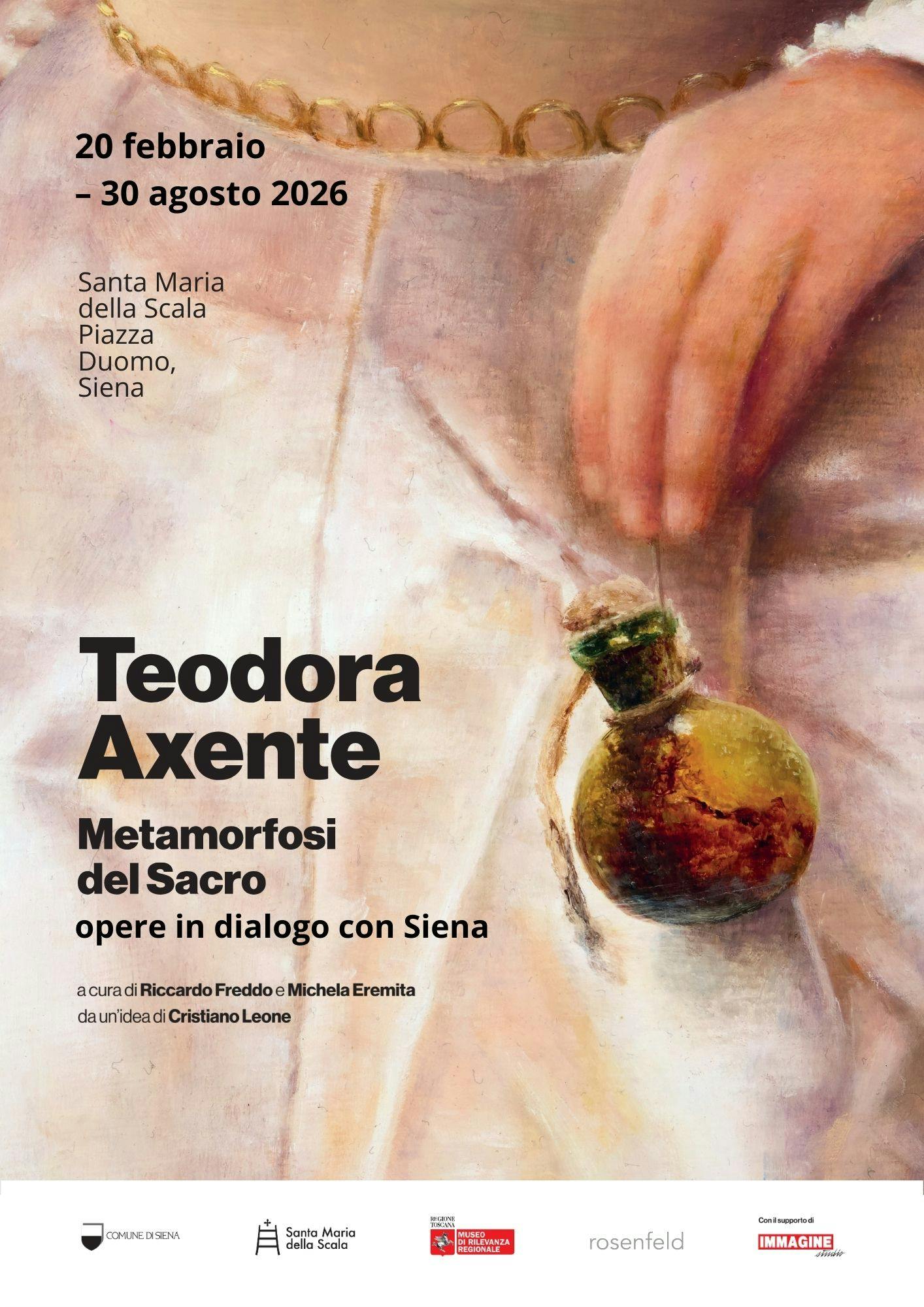
From February 20 to the end of August 2026, the former stable of the Santa Maria della Scala museum complex hosts the reinstallation of the exhibition Metamorphoses of the Sacred by Teodora Axente, with a selection of 14 works. The exhibition, curated by Riccardo Freddo and Michelina Eremita, was conceived on the occasion of the artist's appointment by the Municipality of Siena as painter of the Palio of August 16, 2026.
The Romanian artist's first institutional solo exhibition in Italy, Metamorphoses of the Sacred is a radically site-specific project that puts contemporary painting into dialogue with the history of Santa Maria della Scala. The exhibition path is structured in thematic totems that convey an intense and visionary style, deeply connected to the spiritual memory of the ancient hospital.
Conceived at the initiative of the President of the Foundation Cristiano Leone and produced in collaboration with the Rosenfeld Gallery, London, the exhibition enhances the historical heritage through a contemporary language, in which hybrid images and evoked presences renew the sense of the sacred. With this project, Teodora Axente – among the most significant voices of contemporary European painting – opens new temporal gateways in the heart of Sienese history.
Teodora Axente (born in 1984) lives and works in Cluj, Romania. A member of the new generation of artists of the Fabrica de Pensule — the historic brush factory of Cluj transformed into one of the most vital cultural centers in Eastern Europe — Axente has developed a deeply narrative painting practice, where the image becomes a place of introspection and metamorphosis. Her works portray enigmatic human figures, often accompanied by animals or surrounded by objects with strong symbolic power: masks, domestic elements, relics, or mysterious presences that seem to come from a dream or from a collective memory. Through these apparitions, Axente explores the tensions between instinct and consciousness, vulnerability and transformation, constructing a universe poised between the sacred and the everyday.
Locations
Others Events
Show all events
- Events
XENOS performance festival 2026
13 Nov 2026/14 Nov 2026The Fondazione Antico Ospedale Santa Maria della Scala from 13 to 14 November 2026 presents the third edition of XENOS, an international festival dedicated to contemporary performance, conceived by Cristiano Leone with the artistic direction of Anna Lea Antolini.
- Exhibitions
12th edition of Open Archives Week
17 Oct 2026/25 Oct 202612th edition of the Open Archives Week
- Guided tours
Visita guidata alla mostra "Remember Joseph Beuys" - 22esima Giornata del Contemporaneo
10 Oct 2026/10 Oct 2026In occasione della 22esima Giornata del Contemporaneo, una visita guidata gratuita al museo per scoprire l'arte e la personalità di Joseph Beuys
- Exhibitions
Santa Maria della Scala. Architecture, projects and visions. An exhibition curated by Luca Molinari
30 May 2026/27 Sep 2026From 30 May to 27 September 2026 the Fondazione Antico Ospedale Santa Maria della Scala presents the exhibition Santa Maria della Scala. Architecture, projects and visions. An exhibition curated by Luca Molinari.
- Film screening
Visita guidata e proiezione del film “Lucrezia e Joseph Beuys” di Pierparide Tedeschi
5 Oct 2026/5 Oct 2026 - #MeetingsAtLaScala
Presentazione del libro "Panis. Storia e archeologia del pane e della panificazione"
3 Oct 2026/3 Oct 2026Sabato 3 ottobre alle ore 17.30 in sala Sant’Ansano sarà presentato il libro “Panis. Storia e archeologia del pane e della panificazione” di Martina Tapinassi, storica e divulgatrice culturale, edito da Arbor Sapientiae.
- Initiatives
Sunday at the Santa Maria della Scala
Every first Sunday of the month, Santa Maria della Scala opens free of charge to the public. An opportunity to visit the museum complex and the National Archaeological Museum.
- Initiatives
“Musei accessibili: autismi, arte e archeologia”
14 Sep 2026/14 Sep 2026Lunedì 14 settembre, la Fondazione Antico Ospedale Santa Maria della Scala organizza la giornata di formazione e workshop "Musei accessibili: autismi, arte e archeologia", un momento di confronto sui temi dell'accessibilità museale e del welfare culturale rivolto a educatori museali, educatori specializzati nell'autismo e associazioni del territorio, per condividere esperienze e strumenti utili alla progettazione di percorsi museali accessibili.
- Guided tours
special tour "A porte chiuse. Dentro il Santa Maria della Scala"
10 Sep 2026/29 Oct 2026A series of special tours, promoted by the Fondazione Antico Ospedale Santa Maria della Scala and the Municipality of Siena, opening to the public for the first time the 18,000 square metres of the museum complex previously inaccessible.


